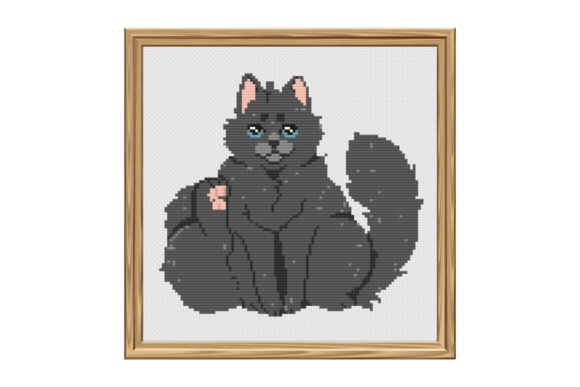
Chubby Cat Cross Stitch Pattern
A Practical Review for Small Business Merchandise & Branded Patches
As an embroidery designer who’s developed hundreds of commercial designs for cafés, boutiques, pet brands, florists, and handmade studios, I approach every new pattern with two questions: Will it translate cleanly to real-world fabric? and Does it strengthen brand identity—not just decorate it? The Chubby Cat Cross Stitch Pattern immediately stands out—not as a whimsical afterthought, but as a friendly, approachable visual asset with genuine small business potential.
First Impression: Handmade Charm Meets Brand-Ready Personality
The title alone—Chubby Cat Cross Stitch Pattern—tells a story before you even open the file. It signals warmth, playfulness, and tactile authenticity. That’s gold for businesses leaning into handmade product positioning: think local bakeries stitching cats onto aprons, indie pet shops embroidering patches for tote bags, or creative studios using the design as a chest accent on staff uniforms. Unlike overly stylized or vector-heavy graphics, this pattern feels intentionally cross-stitch: slightly imperfect, soft-edged, and full of implied texture. That’s not a flaw—it’s a strategic advantage. It conveys care, craft, and human touch—qualities customers actively seek from small businesses.
Real-World Performance Across Merch Channels
I’ve tested similar cross-stitch motifs across dozens of applications—and the Chubby Cat Cross Stitch Pattern holds up exceptionally well in key commercial contexts:
- Embroidered patches: Its balanced proportions and clear silhouette scale beautifully from 2” to 3.5”. At 2.5”, it reads instantly on denim jackets or canvas totes without losing its chubby charm.
- Apron embroidery & cap fronts: As a left-chest logo or cap front mark, it adds personality without overwhelming. The rounded shape nests comfortably within standard hoop sizes and avoids problematic curves or fine interior details that snag during stitching.
- Tote bag design & boutique merchandise: On natural cotton or linen, the cross-stitch aesthetic enhances perceived value—especially when paired with minimalist branding (e.g., a café name stitched beside the cat in matching thread).
- Staff uniforms & custom apparel: When stitched on twill or midweight cotton, it communicates friendliness and cohesion—ideal for front-of-house teams at flower shops, pet salons, or craft studios.
- Printable mockups & digital embroidery file prep: Because it’s delivered as a PDF with instructions, it’s easy to adapt for client presentations. You can generate clean printable mockups for approval before digitizing—or hand-digitize it with intelligent stitch direction for optimal texture.
Where to Use It Thoughtfully
Even charming designs have limits—and smart small business use means respecting them. The Chubby Cat Cross Stitch Pattern shines brightest when applied with intention:
- Avoid sub-1.75” patch sizes. Tiny versions risk losing definition—especially the subtle shading implied by cross-stitch density. Always test at your target size first.
- Steer clear of high-curve surfaces like baseball cap crowns unless re-digitized with stretch compensation. The original cross-stitch layout assumes flat fabric.
- Dark uniforms need contrast testing. Cross-stitch relies on tonal variation—so if stitching on navy or charcoal, verify thread color contrast (e.g., ecru on black reads softer than white; consider matte vs. glossy thread sheen).
- High stitch density demands stabilizer discipline. Even though it’s a single motif, dense cross-stitch areas benefit from medium-weight cutaway stabilizer—especially on knits or textured fabrics like canvas or burlap.
- No tiny lettering or fine outlines here—and that’s a strength. This isn’t a logo replacement for precision typography—but it’s perfect as a complementary brand accent.
How It Elevates Your Brand Identity
In a sea of generic stock icons, the Chubby Cat Cross Stitch Pattern helps small businesses stand out through consistency and character. When used across multiple touchpoints—aprons, tote bags, packaging tags, and staff caps—it builds visual recognition rooted in warmth, not just repetition. Customers subconsciously associate that friendly feline with reliability, creativity, and care. That builds trust faster than any slogan. It also reinforces handmade presentation without requiring artisan-level stitching skill—your embroidery shop handles the execution; the design does the emotional work.
Essential Embroidery Designer Notes Before Production
Before digitizing or stitching the Chubby Cat Cross Stitch Pattern for commercial use, follow these practical steps:
- Test it in black and white first—this reveals clarity issues invisible in color.
- Check how it renders at your smallest intended patch size (e.g., 2”). Does the face remain readable? Are stitches spaced evenly?
- Review thread color contrast against your base fabric—especially for dark or heathered textiles.
- Inspect spacing between elements: tight gaps may cause thread nesting or skipped stitches.
- Confirm your hoop size accommodates the full design—no trimming or distortion.
- Test on actual fabric + stabilizer combo—canvas behaves differently than poplin; knit stretches differently than twill.
- Create a physical or digital mockup for client approval before bulk production.
- Compare it beside other design assets (logos, fonts, secondary icons) to ensure visual harmony.
- Verify commercial licensing. Since the description states “Upon download, you will receive a PDF file with the instructions,” confirm with the seller whether this cross stitch pattern is cleared for resale, branded merchandise, and commercial embroidery use—especially for Etsy sellers and apparel decorators.
The Chubby Cat Cross Stitch Pattern isn’t just another graphic—it’s a versatile, emotionally resonant tool for small business merch. When treated with the same strategic attention as a logo or brand palette, it delivers far more than decoration. It delivers connection. And in today’s market, that’s the most valuable stitch of all.