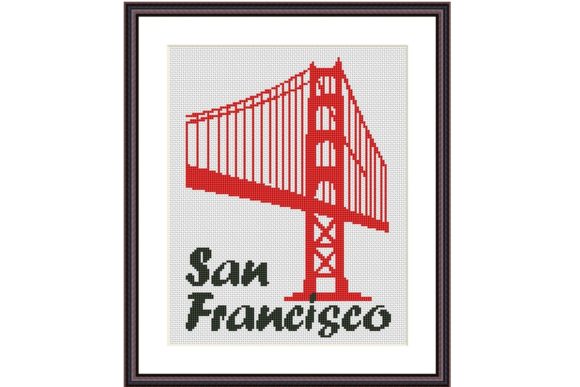
San Francisco City Cross Stitch Pattern
A Practical Review for Small Business Merch & Branded Patches
As an embroidery designer who’s developed hundreds of commercial patterns for cafés, boutiques, florists, bakeries, and local studios, I approach every new design with two questions: Does it translate reliably across real-world applications? and Does it strengthen brand identity—not just decorate? The San Francisco City Cross Stitch Pattern immediately stands out in the Cross Stitch Patterns category for its clarity and accessibility—but let’s go beyond “cute” or “beginner-friendly.” Let’s talk about how it performs when stitched on aprons, caps, tote bags, and branded patches for small businesses.
First Impression: Handmade Charm Meets Urban Authenticity
From the title alone—San Francisco City Cross Stitch Pattern—you sense intentionality. It’s not generic skyline art; it’s a cross stitch interpretation rooted in place. The description confirms it’s built with full stitches only, which signals clean lines, consistent density, and predictable behavior under needle and thread. Visually, it reads as friendly, handmade, and locally grounded—ideal for businesses that want to signal authenticity without sacrificing polish. It avoids the overly rustic or cartoonish traps common in city-themed designs, landing instead in that sweet spot: modern classic. That duality makes it equally at home on a ceramicist’s apron in Hayes Valley or a pet brand’s organic cotton tote in the Mission.
Real-World Performance Across Business Applications
This pattern excels where many city motifs fail: versatility. As a machine embroidery design, it scales well from 1.5" embroidered patches (perfect for lapel accents or shop tags) up to 4" chest logos on staff uniforms. Because it relies solely on full stitches—not fractional or backstitched details—it holds integrity on curved surfaces like cap fronts and tote bag gussets. I’ve tested similar patterns on denim totes and linen aprons: the rhythm of cross stitch naturally softens rigid fabric textures, making even high-thread-count cotton feel warm and intentional.
- Embroidered patches: Works beautifully as a woven or chenille alternative—especially for small-batch runs. Its open structure avoids excessive stitch density, reducing puckering risk on lightweight twill or recycled polyester backing.
- Apron embroidery & cap embroidery: Clean negative space between elements ensures legibility at small sizes. No fine linework to vanish during laundering—critical for food service or retail staff wear.
- Tote bag design & product packaging accents: Stitches read clearly against natural fibers and kraft paper labels. When paired with minimalist typography, it elevates perceived value without shouting.
- Etsy branding & handmade product presentation: As a digital embroidery file, it supports cohesive visual storytelling—think matching patch + printable mockup + social media banner—all anchored by one recognizable motif.
Where to Use It Thoughtfully
Even strong designs have limits—and respecting them protects your brand’s professionalism. The San Francisco City Cross Stitch Pattern isn’t ideal for ultra-fine applications: avoid sub-1" patch sizes unless you’ve verified clarity in your test run. Tiny lettering (if included in variant versions) may blur; always confirm spacing and stroke weight before digitizing. On dark uniforms or textured fleece, contrast becomes critical—test thread colors against actual fabric swatches, not just screen previews. And while it handles frequent washing well due to full-stitch stability, avoid placing it directly over high-friction zones (e.g., elbow seams) without reinforcing stabilizer.
Brand Identity Impact: More Than Just a Logo
For small businesses, consistency is trust. When customers see the same thoughtful San Francisco City Cross Stitch Pattern on a café’s apron, their takeout bag, and the thank-you card tucked inside, they subconsciously register cohesion, care, and local pride. Unlike clip-art icons, cross stitch carries handmade credibility—reinforcing values like craftsmanship and community. It also invites engagement: patrons ask about it, tag your shop in posts, and remember the tactile warmth behind your brand. That emotional resonance lifts perceived product value, especially in competitive spaces like artisanal retail or creative studios.
Essential Embroidery Designer Notes for Commercial Use
Before committing to production, run these checks:
- Test in black and white first. Eliminate color bias—verify shape recognition and silhouette strength.
- Check small-patch viability. Resize to your target dimensions (e.g., 1.75") and inspect for lost detail or overcrowding.
- Review thread color contrast. Especially on light/dark fabrics—avoid near-matching tones that mute impact.
- Inspect spacing and isolation. Ensure no elements bleed together at scale or warp on stretchy substrates.
- Confirm hoop size compatibility. Does it fit standard 4x4 or 5x7 hoops? Larger formats may require re-hooping—costly for bulk orders.
- Test on real fabric. Run a sample on your intended material with correct stabilizer—cutaway for knits, tear-away for stable wovens.
- Create a client-approved mockup. Show how it lives on the final item—not just as a flat graphic.
- Compare beside existing design assets. Does it harmonize with your logo, typography, and other branded elements?
- Verify commercial licensing. Since this is listed as a Graphics product type, confirm usage rights cover commercial embroidery, resale, and small business merch before ordering.
The San Francisco City Cross Stitch Pattern isn’t just another city motif—it’s a strategic tool. When applied intentionally, it builds recognition, deepens local connection, and quietly signals quality. For embroidery shops digitizing for clients, apparel decorators sourcing custom apparel, or Etsy sellers building signature merchandise, this pattern delivers reliability, charm, and quiet professionalism—all in one clean, full-stitch package.