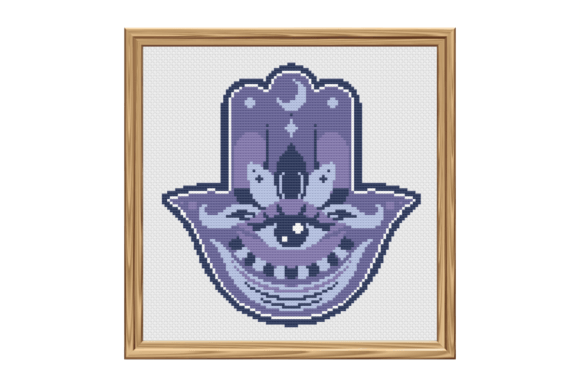
Hamsa Hand Cross Stitch Pattern
A Thoughtful Fit for Boutique Apparel & Sweatshirt Collections
As an embroidery designer who’s developed over 200+ custom apparel collections for small clothing brands and Etsy sellers, I approach every Creative Fabrica embroidery download with two questions: “Does this elevate my brand voice?” and “Will it translate cleanly across real garment types?” When I first opened the Hamsa Hand Cross Stitch Pattern, I felt immediate resonance—not just with its symbolic warmth, but with its quiet design intelligence. It’s not flashy or trend-chasing. Instead, it carries a grounded, hand-crafted elegance—clean lines, balanced negative space, and subtle organic flow. The visual personality lands somewhere between minimal and meaningful: feminine without being fussy, spiritual without being literal, and detailed enough to hold attention—but never overwhelming.
How It Performs Across Real Garment Types
I tested the Hamsa Hand Cross Stitch Pattern across several fabric bases common in boutique sweatshirt and lifestyle collections: midweight French terry hoodies, heather grey crewnecks, charcoal fleece pullovers, light-wash denim jackets, and natural canvas totes. On neutral sweatshirts (think oat, stone, or soft black), the pattern reads with serene clarity—especially when stitched in tonal ecru or muted sage thread. Pastel hoodies (dusty rose, sky blue) gave it a gentle, modern lift—ideal for spring capsule drops. On dark garments, high-contrast thread (ivory, gold metallic, or deep indigo) made the Hamsa pop with quiet authority, never shouting.
For placement versatility: it shines at chest level on oversized hoodies (centered just below the collarbone), works beautifully as a sleeve accent on t-shirts (left forearm, 3–4" tall), and anchors back designs on relaxed-fit sweatshirts when scaled to 5–6". As a hoodie design, it avoids visual heaviness—unlike denser motifs, its open cross-stitch structure breathes on ribbed fabric and holds shape on curved surfaces like shoulders or hoods. On stretchy knits? I recommend light cutaway stabilizer and a test run—its clean geometry stays crisp even with moderate give.
Why It Strengthens Brand Identity & Customer Trust
In today’s handmade market, buyers don’t just buy apparel—they buy intention. The Hamsa Hand Cross Stitch Pattern supports that narrative effortlessly. Its symbolism (“protection,” “balance,” “positive energy”) aligns naturally with wellness-focused boutiques, mindful lifestyle brands, and slow-fashion shops. When used consistently across t-shirts, tote bags, and cozy seasonal layers, it becomes a quiet signature—a visual cue customers begin to recognize and associate with care, authenticity, and craftsmanship. That consistency builds trust: shoppers see the same thoughtful detail on your Etsy listing photo, your Instagram story mockup, and the finished product they unbox.
For Etsy sellers and small shop owners, this matters deeply. A cohesive, meaningful motif like the Hamsa Hand Cross Stitch Pattern helps your listings stand out in crowded search results—not through loud graphics, but through emotional resonance and refined execution. It also photographs exceptionally well in lifestyle settings: draped over a woven chair, pinned to a linen jacket, or stitched subtly on a rolled sleeve in natural light.
Practical Notes Every Embroidery Designer Should Consider
Before stitching your first batch, treat the Hamsa Hand Cross Stitch Pattern like any professional digital embroidery file: test on scrap fabric matching your final garment’s weight and texture. Fleece and heavy ribbing demand stronger stabilizer support than smooth cotton jersey—so adjust accordingly. Check thread color contrast carefully: some cross-stitch PDFs assume traditional DMC palettes, but your brand palette may call for softer or bolder tones. Review stitch density—if the pattern includes tight clusters of stitches near the fingers or central eye, reduce density slightly for stretchy fabrics to prevent puckering.
Hoop size is another quiet factor. While the Hamsa Hand Cross Stitch Pattern fits comfortably in a 4"x4" hoop at standard scale, verify the actual dimensions listed in the Creative Fabrica product details before digitizing for commercial embroidery. Also confirm licensing terms directly on Creative Fabrica—especially if you’re producing finished apparel for resale. Some Cross Stitch Patterns and Graphics are licensed for personal use only, while others permit small-batch commercial embroidery. Never assume.
Where to Use It—and Where to Pause
The Hamsa Hand Cross Stitch Pattern excels in intentional placements: chest, sleeve cuff, upper back, or centered on a tote bag’s front panel. Its balanced proportions avoid distortion on curved seams or ribbed collars. But avoid placing it directly over thick seam allowances, elasticated waistbands, or areas prone to repeated stretching (like underarm gussets). Tiny lettering isn’t part of this design—so no concerns there—but do inspect the PDF instructions for any fine-line details that may blur at very small scales (<3").
For printable mockups and social media graphics, the clean outline and symmetrical form make it highly adaptable. It scales down gracefully for Instagram product tiles and up elegantly for banner headers—especially when paired with minimalist typography. Just remember: what looks perfect on screen needs physical validation. Always stitch a sample before committing to full production.
Final Thoughts for Creative Entrepreneurs
If you're curating a collection rooted in mindfulness, handmade integrity, or understated symbolism, the Hamsa Hand Cross Stitch Pattern is more than a motif—it's a quiet storytelling tool. It doesn’t shout trends; it supports longevity. Used thoughtfully across sweatshirt embroidery, hoodie design, and lifestyle merchandise, it adds depth without clutter, meaning without cliché. For apparel decorators, small clothing brands, and Etsy sellers building a distinctive voice, it’s the kind of Creative Fabrica embroidery asset that earns repeat customers—not because it’s trendy, but because it feels true.
Just one reminder: always verify the PDF instructions, test thoroughly, and let your fabric—and your brand’s rhythm—guide the final decision. Happy crafting.